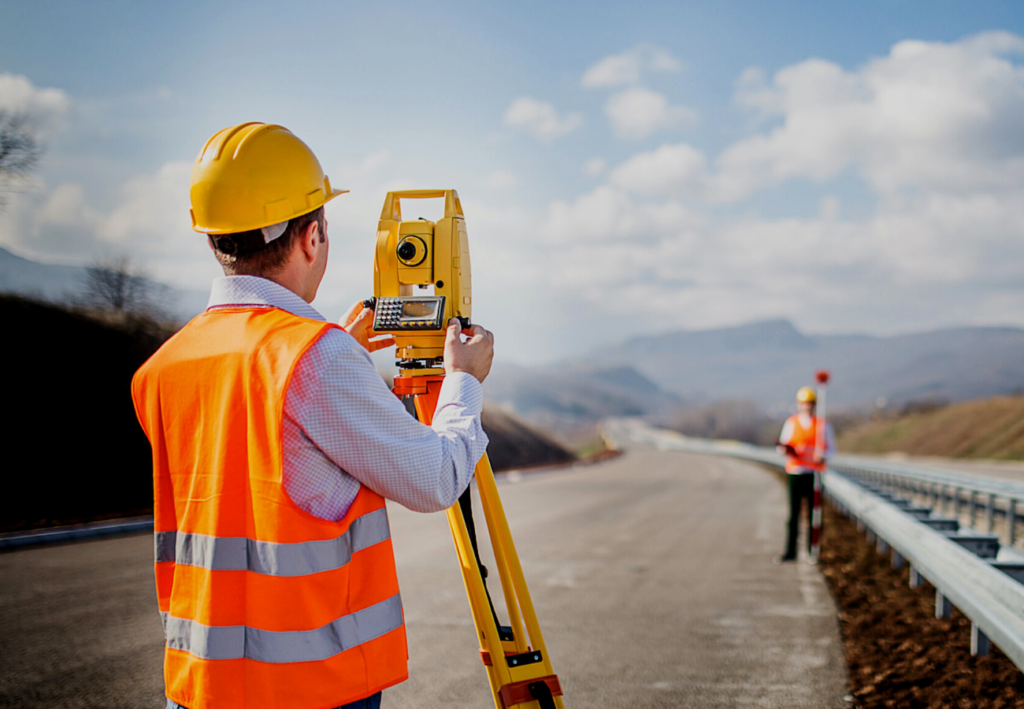
Monitoring surveying uses precise techniques (like total stations, GPS, laser scanning) to track movement, deformation, or condition changes in structures, land, or features over time, crucial for construction safety, infrastructure stability, and identifying risks like ground settlement or structural shifts, often involving regular site visits and detailed reporting. It ensures compliance, manages project risk, and provides early warnings of potential failures before they become catastrophic.
A strategic Monitoring Surveying process provides essential data to a construction project by identifying movement or deformation in a building or structure, as well as any environmental impacts such as noise, dust, and vibration. The data can help determine whether remedial action is needed or to inform the next stage in the project.
Why Structural & Environmental Monitoring Surveying Matters
A structural and environmental monitoring survey process gives reassurance that any potential problems can be identified and corrected as quickly as possible. The data is essential for professionals involved in projects like building construction, tunnelling, and infrastructure development to ensure safety and stability. This can include construction managers, engineers, and geotechnical professionals, as well as maintenance project teams.
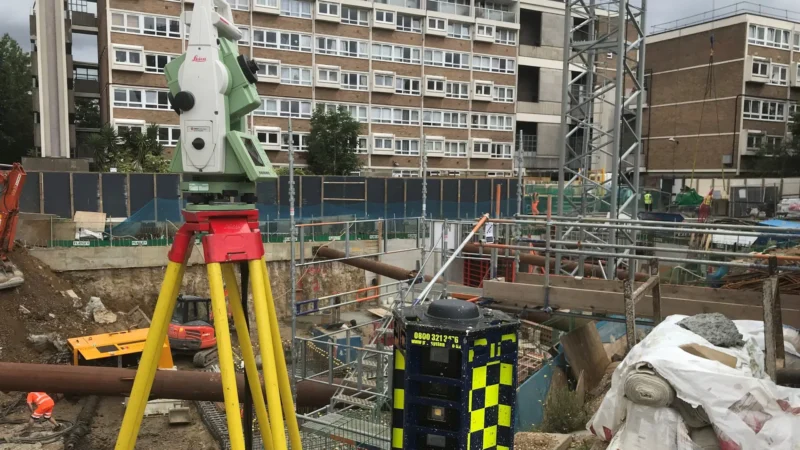
In essence, monitoring surveying provides an objective, data-driven view of a site’s physical stability, acting as an early warning system for potential problems. In terms of safety, the process prevents structural collapse and protects workers and the public. Financially, it helps reduce costly repairs, avoids project delays, and mitigates liability. As for compliance, it helps meet regulatory and lender requirements for ongoing project oversight.
The Key Aspects:
- Purpose: Detects movement (settlement, convergence, displacement) in buildings, bridges, dams, slopes, or tunnels, even before visible signs.
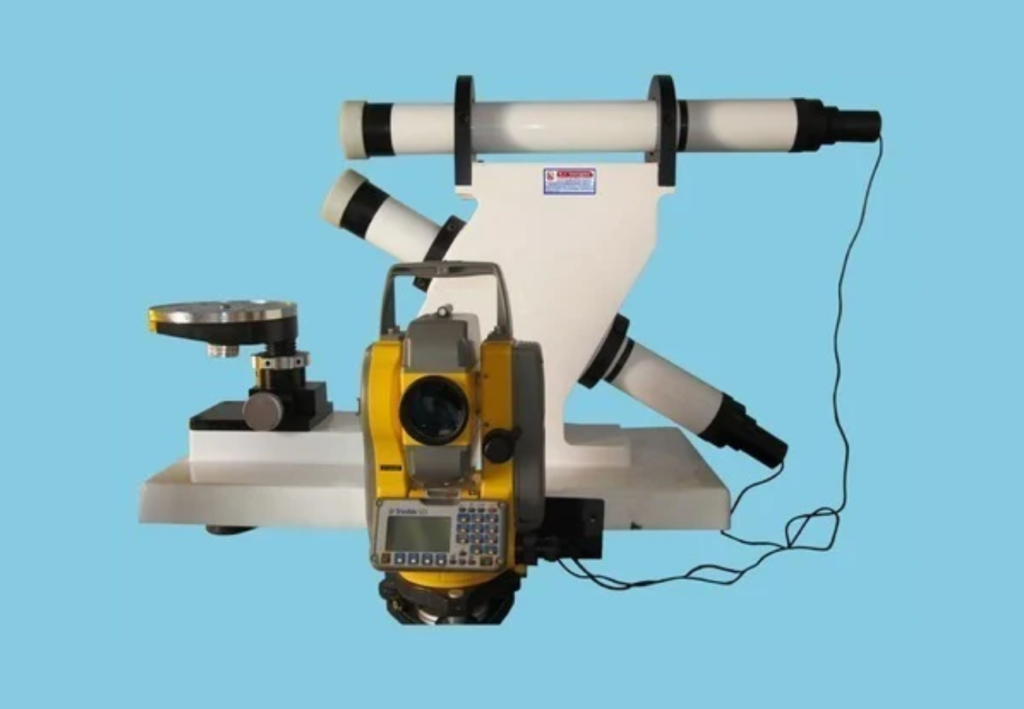
- Methods: Uses high-precision instruments like total stations, digital levels, GPS/GNSS, 3D laser scanners, and sometimes drones or video recording for continuous data collection.
- Applications:
- Construction: Monitoring excavation impacts on nearby structures (dilapidation surveys), ensuring new builds don’t deform existing ones.
- Infrastructure: Tracking bridges, tunnels, railways, and dams for long-term stability.
- Geotechnical: Monitoring landslides, subsidence, or ground stability.
- Process: Involves establishing control points, repeated measurements, analyzing data against baseline surveys, and generating reports (often with 3D models).
- Frequency: Varies from daily to monthly or longer, depending on project risk, lender requirements, and construction phase.
Be that as it may, the specialist team from Medir Instruments Limited will design, specify, install, and carry out monitoring schemes on buildings – from new build to heritage properties – as well as major structures including bridges, sea defences, and retaining walls. Our solutions combine the latest technology alongside cloud-based hosting and reporting systems.
Our team reviews all of the data, but this can easily be shared with the project team through secure online portals. We can map small changes in vertical, level, and horizontal movement or full 3D XYZ coordinate differences in either real-time or over long periods. Depending on the project, a monitoring surveying process can be either manual or automated, with ongoing data produced so that trends or patterns can be identified.
Our range of services also includes environmental monitoring surveying to enable a greater understanding of the role and impact of noise, dust, and vibration on both buildings and the surrounding environment. This can be applied to newly-established residential developments, as well as existing commercial, retail, leisure, and heritage buildings.
What You Need From Monitoring Surveying Solutions:
- Reliable, accurate, and precise data aid fast and effective decision-making.
- Leading monitoring technologies and software delivering real-time and accurate results.
- A one-stop solution where we can combine structural, environmental, and geotechnical services, eliminating the need for additional suppliers to help you manage costs and improve efficiency.
- The option for one hosting platform so all data is in one place, avoiding the need for multiple systems and information presented in different formats, which can lead to data misinterpretation.
- Quick response times, both in terms of site installation and setup, and in providing data and alerts ideal for projects with tight schedules or critical safety concerns.
In addition, you may need the ability to tailor and customise your solutions to the specific needs of your project. Likewise, your project training teams must ensure consistent knowledge across all users and allow new team members to be trained quickly.
The Environmental Monitoring Surveying Process
By all means, the environmental monitoring process involves the systematic observation and analysis of the impact caused by construction activities. This includes monitoring air quality, dust emissions, noise and vibration levels, and the effect caused on the local environment.
These services support various project sectors from the build of new developments through to measuring the impact caused by existing buildings, including commercial, retail, leisure, and heritage. Equally important, it’s also wise to highlight the effects of noise, dust, and vibration on the environment.
Consider the following:
- Air Quality: Construction sites can generate air pollution, including dust, particulate matter, and volatile organic compounds (VOCs). Measuring the levels of these pollutants ensures they are within safe limits, protects the health of workers and the community, as well as prevents legal penalties.
- Vibration: Construction and demolition activities can produce high levels of vibration, which can have an adverse effect on nearby buildings and infrastructure. Measuring vibration levels ensures they remain within set parameters.
- Noise: Noise from construction works can be dangerous and disruptive both on-site and to the surrounding community. Measuring the peak and average levels of noise ensures they remain within their designated limits.
Measuring noise, dust, and vibration as part of the environmental monitoring surveying process can help mitigate the risk of site closure while supporting the safety and well-being of the community.
Other benefits include:
- Compliance: Construction sites must adhere to Section 61 regulations, which involve Noise, dust, and vibration (NDV). Environmental monitoring programmes can ensure compliance is being upheld, and remedial measures can be quickly implemented if any breaches were to occur to prevent legal penalties.
- Efficiency: Identifying and addressing concerns at the earliest opportunity saves significant costs associated with repairs and downtime, whilst maintaining the customer’s reputation.
- Planning: Construction sites can be a source of frustration and concern for nearby residents. By monitoring the environment using a range of sensors and taking steps to address any issues that arise, construction companies can help build positive relationships with the community.
For your information, our environmental monitoring surveying process helps deliver various benefits. Firstly, there’s the regulatory compliance and reporting, which helps ensure compliance is upheld, preventing site closures and legal penalties. Secondly, it helps reduce environmental impact, whereby reporting on the negative environmental impacts of construction activities allows for correct remedial action.
At the same time, our expert monitoring surveying method helps in sustainable project management. Eventually, this helps in supporting the development of sustainable construction projects that are considerate of their ecological footprint.
We can support your project with a range of environmental monitoring services where the scope of the project can extend to monitoring impacts such as noise, dust, and vibration. This can be included within the specification alongside a structural monitoring programme or as a bespoke package of work. We can work with you from an early stage to see how our full range of monitoring services can be combined into one customised package of work to meet your project requirements.
The Structural Monitoring Surveying Process
Technically, the structural monitoring process involves the continuous or periodic observation and analysis of the structural integrity of buildings, bridges, dams, and other infrastructures. This process uses various sensors and technology to detect and measure movements, vibrations, and other changes that might indicate potential structural issues.
You need reliable condition data and alerts, provided by a programme of monitoring. Our monitoring surveys record and measure the movement or deformation of a building or structure across a broad range of projects. From new build developments through to historic and heritage landmarks, a monitoring scheme can help identify any potential issues within a structure and allow a plan of remediation to be established before further problems develop.
We work to a high level of accuracy, with project specifications being established for movement as precise as sub mm. We can also supply our clients with real-time project data, ensuring that any problems can be identified and communicated via SMS or email immediately so that appropriate action can be undertaken on site. Markedly, our structural monitoring surveying programmes are known to deliver some clear benefits.
Consider the following:
- Early Detection of Structural Issues: Helping to identify potential structural problems before they become severe, ensuring timely interventions
- Safety and Risk Management: Enhancing the safety of the structure by continuously monitoring its health, thereby reducing the risk of unexpected failures.
- Maintenance Optimisation: Aiding in the efficient planning of maintenance and repair work, avoiding unnecessary expenses and extending the lifespan of the structure.
Automated Vs. Manual Monitoring
Our monitoring programmes generally fall into two distinct categories. A fully automated monitoring scheme where we will attend the site and install monitoring technology that can continuously measure fixed points 24/7. Our solutions combine the latest in monitoring technologies alongside cloud-based data hosting and reporting systems.
Our monitoring team reviews all data, but this is also shared with the project team through online secure portals. Data sets can be provided for timeframes that suit you best, but should any movement be detected in the meantime, we can use alert systems to communicate with you by text message or email, should pre-determined tolerance levels be breached.
The second option is a manual monitoring scheme, which can be set up quickly, with our team available to attend the site on a regular basis to consistently measure the monitoring targets. The frequency of attendance is normally specified by the client at the start of the project, but can change in line with changing site activity. You will be provided with an ongoing set of data, generally in spreadsheet format, although other data and outputs, such as 3D digital models, are also available.
Previous survey data can also be provided to check for any noticeable trends or patterns in movement. As well as movement monitoring and deformation monitoring, our teams can support precise levelling, coastal erosion monitoring, crack monitoring, groundwater monitoring, vibration monitoring, and environmental monitoring. There are notable environmental, social, and governance benefits to note.
Summary:
- Environmental: Contributes to sustainable infrastructure management by preventing wasteful resource use in unnecessary repairs.
- Social: Ensures public safety and trust by proactively managing the integrity of essential structures.
- Governance: Helps in complying with safety regulations and standards in construction and infrastructure management.
That’s it! To find out more, please visit the Contact Us Page to get in touch with one of our specialist surveyors. Available across our network of nationwide offices, our teams of surveyors share many years’ experience and are in an ideal position to discuss your project in more detail and offer the best survey solution from our broad range of complementary services.